

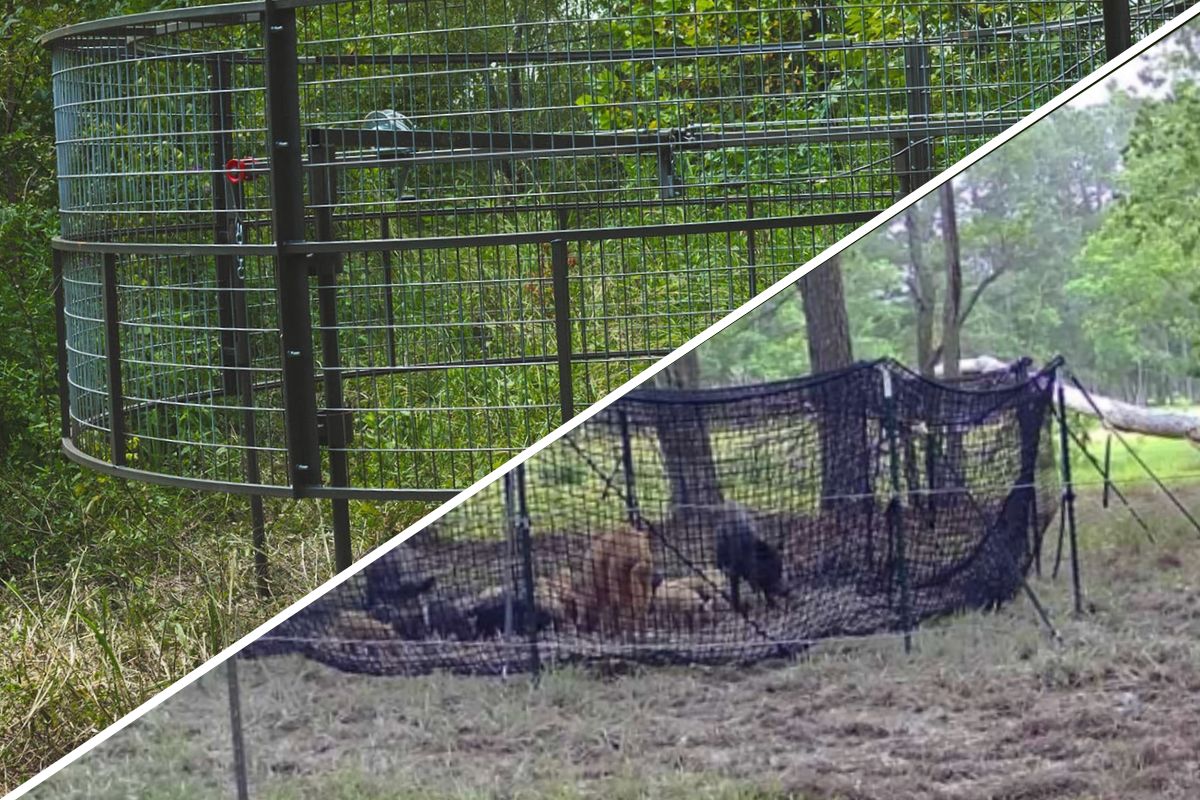
If you are comparing hog traps for whole-sounder capture, you will run into two very different tool classes: active steel drop systems and passive net systems. The Big Pig Drop Trap sits in the first group. Pig Brig sits in the second. Both aim at removing family groups instead of educating survivors into being trap shy. How they get there is not the same.
This is a fair, mechanism-first comparison. We will not invent competitor specs or copy competitor marketing language. Check each manufacturer's current product pages for exact figures.
Shared Goal: Catch the Whole Sounder
Partial captures are expensive in the long run. The hogs that escape learn the trap, keep breeding, and make the next attempt harder. Whole-sounder capture is the job. The question is which mechanism fits your ground, crew, and willingness to run remote triggers versus a continuous-catch net.
Mechanism: Steel Drop vs Passive Net
The Big Pig Drop Trap is a fully suspended, four-section circular steel frame, 48" high and 13' in diameter, with open entry from every angle and a 10" jump ring. Hogs condition to the site. When the full group is inside, you drop the frame. That drop is typically remote, via the HogEye Camera System (camera and trigger layer, not a trap type).
Pig Brig-style systems are passive net traps. Pigs push under a net skirt to reach bait, and the design is meant to keep catching as more animals enter without a timed gate drop. That continuous-catch model is the core of the net category. It does not use a steel drop frame or a one-tap cellular gate the way a Big Pig setup does.
Deployment, Labor, and Relocation
Big Pig engineers for land reality: no single piece over 85 lb, roughly one-third the parts of some competing drop traps, and realistic one- or two-person assembly. For panel systems, the A-frame Panel Trap Trailer moves panels upright instead of in a flat stack. If you relocate often between pressure points, weight and transport matter as much as the catch method.
Passive nets trade steel mass for fabric and T-post setups. That can favor pack-in terrain. It also means containment depends on net anchoring, skirt behavior, and how the wall holds when a full sounder charges. Those are net-category engineering choices, not steel-drop choices.
Remote Triggering vs Continuous Catch
With a Big Pig drop or panel system, you watch the site, wait for the entire sounder, then trigger. HogEye stays "Always Awake," responds in under a second, and offers one-tap drop control on AT&T or Verizon with a no-contract data plan. Timing is the point.
With a passive net, the system is designed to keep catching without that same remote decision moment. Optional triggers exist in the broader net market, but the default value proposition is unattended continuous catch without cell service. Choose based on whether you want operator-timed whole-group drops or a passive overnight catch model.
When Each Fits
- Steel drop / panel + HogEye: you want remote eyes, one-tap control, and heavy-duty steel containment for whole-sounder events on properties where you can run cellular monitoring.
- Smaller or trap-shy sounders: open-entry drop traps are often the better Big Pig fit; larger populations may favor a panel trap.
- Passive net: you prefer continuous-catch net mechanics and are evaluating that category on its own published specs and field claims.
Big Pig Trap is not a net brand. If you want steel drop or panel systems with integrated remote triggering, start on the traps collection, read Why Big Pig, or call the Hog Trap Hotline at 888-744-8727.
Frequently Asked Questions
Is Pig Brig the same as a Big Pig drop trap?
No. Pig Brig is a passive net system. Big Pig Drop Trap is a suspended steel frame designed for remote whole-sounder drops.
Does Big Pig sell net traps?
No. Big Pig builds steel drop and panel systems. Passive net trapping is a different product class.
Can I run a Big Pig trap without HogEye?
Systems are built to pair with HogEye for remote monitoring and triggering. HogEye is the camera and trigger system, not a separate trap type.
Which is better for trap-shy hogs?
Open-entry steel drop traps are often a strong fit for smaller or trap-shy sounders because you can wait for the full group before you drop.
Where do I get exact competitor specs?
From each manufacturer's current product pages. Do not rely on secondhand summaries for pricing or hardware details.
Share:
How High-Volume Hog Removal Lowers Ranch Fly Pressure
Cellular Hog Trap Gates: How Remote Triggers Catch the Whole Sounder